

Give a stranger a discount on your house and the IRS barely notices. Offer the same discount to your daughter and you’ve got paperwork to file. Same house, same price cut, two very different tax events.
That split is behind most of the confusion I hear from owners thinking about selling below market value. I’ve bought houses from people in just about every situation, and the tax questions come up almost every time.
What Does Selling a House Below Market Value Mean?
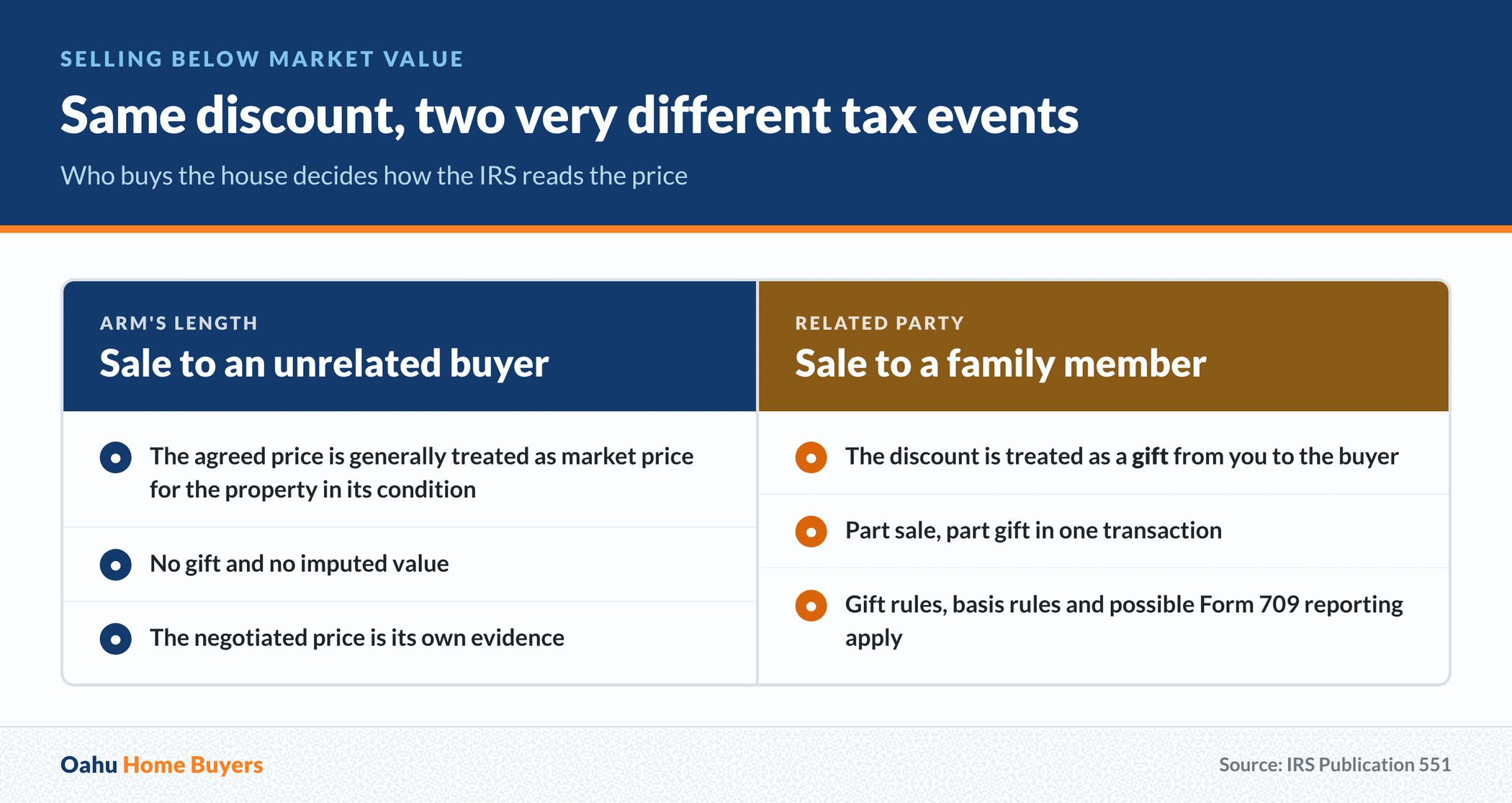
No IRS rule says you have to sell for a certain price. You could sell for a dollar, or for half of what the neighbor got. What the tax code cares about is the gap between what you took and what the place was worth, and who got the benefit of that gap.
Fair market value is the price a willing buyer and a willing seller would agree on, with nobody under pressure and both knowing the facts. Any price under that number is a discount, and every tax question in this article gets measured against it.
A sale at arm’s length works differently from a sale to someone you love. When you sell to an unrelated cash buyer who takes on the risk and the repairs, the price you agree on generally counts as market price for the house in its condition. There’s no gift and nothing extra to report.
Now sell that house to your son for a third of what a stranger would pay. The discount starts to look like a transfer of wealth, and the tax code calls it a part-sale, part-gift. One closing ends up carrying two sets of rules.
Why does that matter so much? Selling to a relative at a discount pulls gift rules, basis rules and possible reporting into a sale you thought was done at closing.
Owners mix up “I got less than Zillow says” with “I sold for less than it’s worth” all the time. Those aren’t the same thing. An online estimate proves nothing, and a house with a failing roof is worth what a house with a failing roof is worth.
How Is Fair Market Value Calculated?
A longtime landlord in Kaneohe called me about a duplex he’d owned since the eighties. His contractor’s bid for a new kitchen came in above what the kitchen would add to the building’s value. He laughed, said he was done, and sold it to me as it stood.
That’s valuation in real life. Fair market value isn’t the number your tax bill shows or what an algorithm guesses. It’s what a real buyer would pay today for the property as it sits.
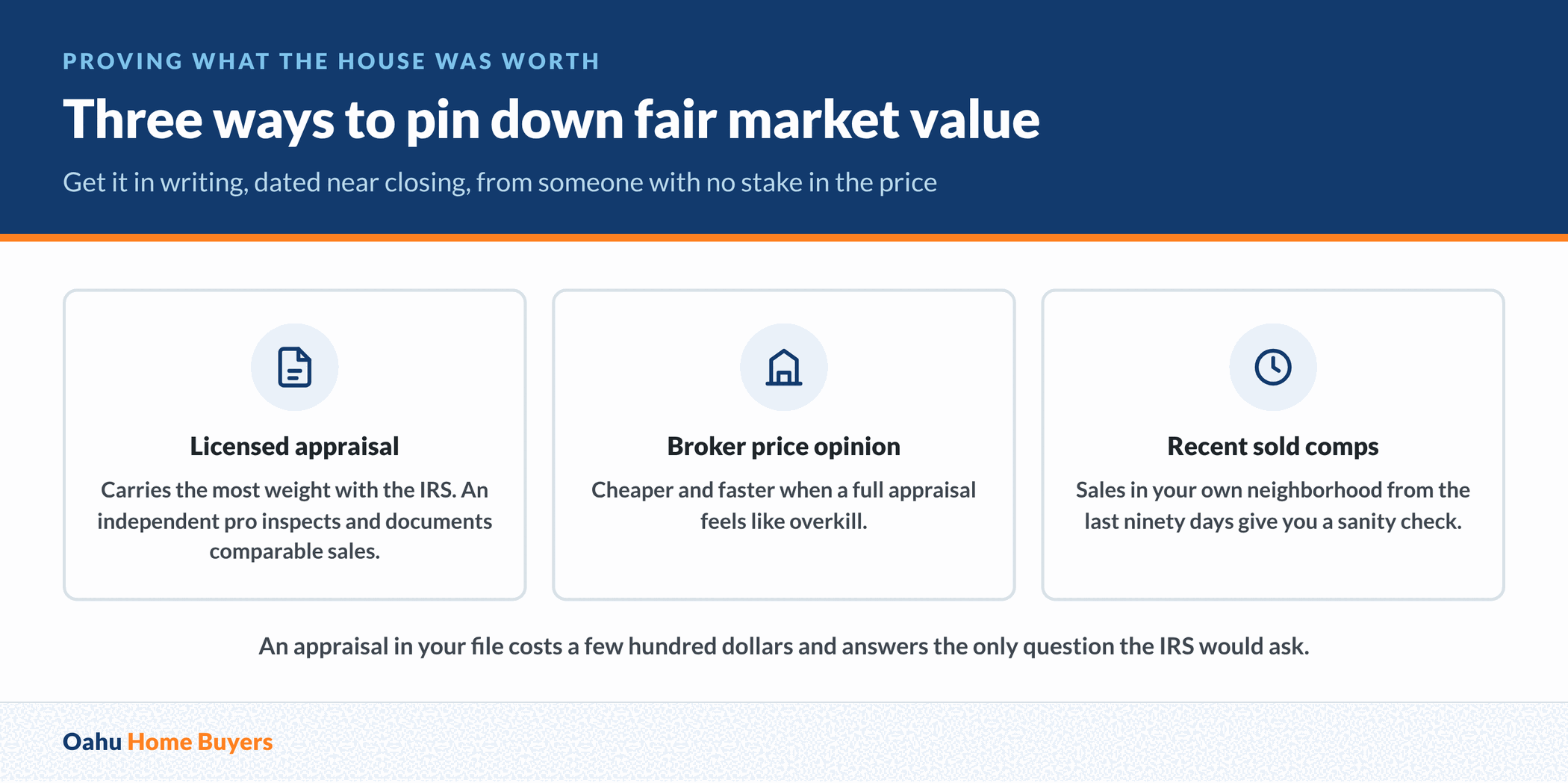
Three tools get you there. A licensed appraisal carries the most weight with the IRS, since an independent pro walks the house and documents comparable sales. Broker price opinions cost less and come back faster if a full appraisal feels like overkill. You can also pull sold comps from your own neighborhood over the last ninety days as a sanity check.
National numbers help you calibrate. Redfin reported a median U.S. home sale price of $388,634 in October 2026, down 0.4% from a year earlier and the first annual drop since May 2023. Homes sat a median of 50 days on market that month. If yours is moving slower and drawing low offers, its market value may just be lower than you hoped.
Paperwork is where people get sloppy. Get the valuation in writing, dated near your closing, from someone with no stake in the price. An appraisal in your file costs a few hundred dollars and answers the one question the IRS would ask about a below market value sale.
Why Would Someone Sell a Home Below Market Value?
Owners take less for plenty of sensible reasons. Some want a parent’s house to stay in the family at a price a child can finance. Others want out of a rental three states away, or out of a divorce standoff before legal fees eat the equity.
Carrying costs keep running while you wait. Mortgage, insurance, utilities and taxes all keep coming on an empty house. Two extra months of that on a $400,000 property can wipe out a good part of the premium you held out for.
Investor offers come in under retail because the buyer takes on the repairs, the holding time and the resale risk. That’s the trade. Some sellers should take it and some shouldn’t, and pricing both paths honestly is the only way to know which group you’re in. Companies like Oahu Home Buyers will walk you through the numbers on both before you pick one.
In the end, your mortgage balance and your timeline usually decide it.
How Does Selling Below Market Value Affect Capital Gains?
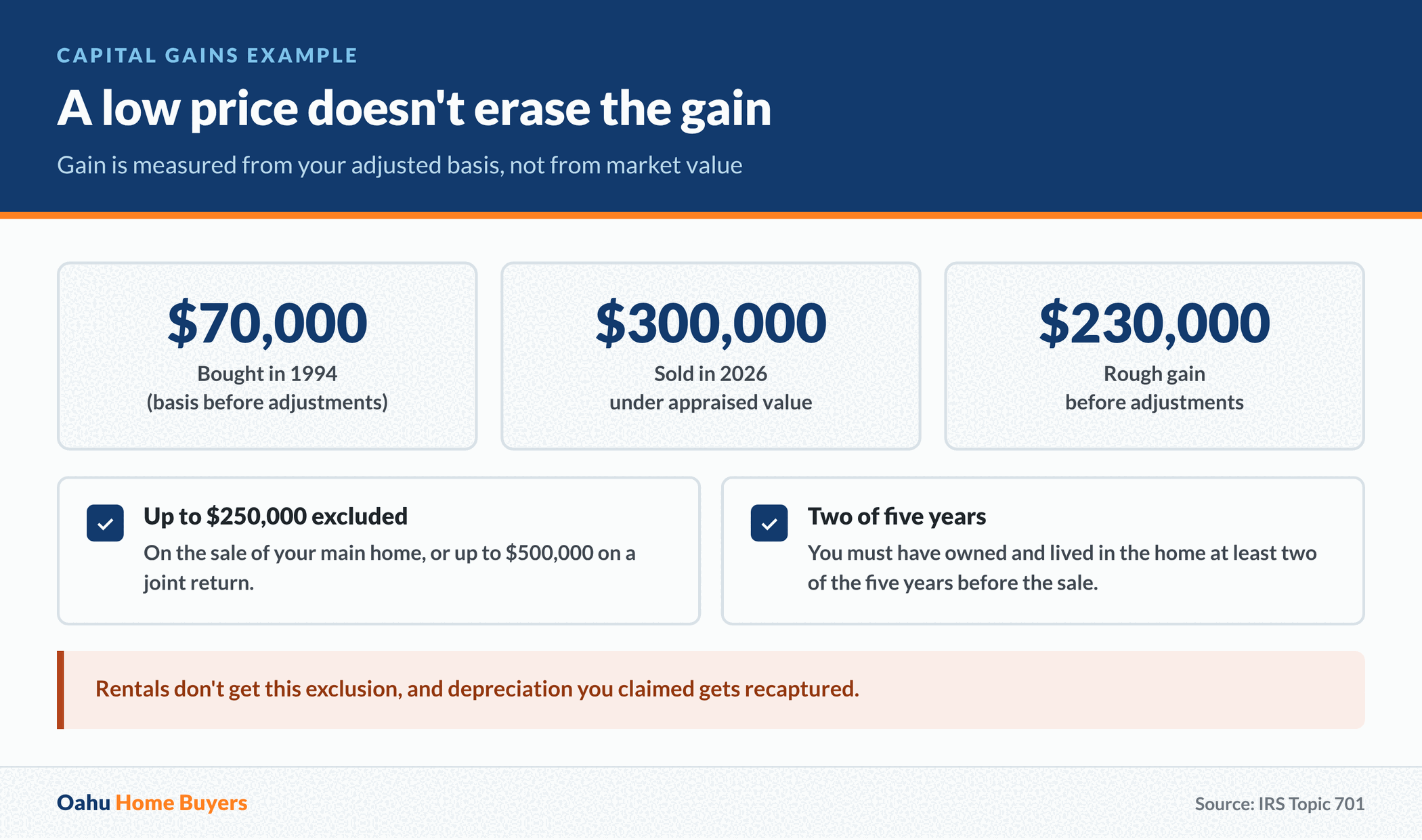
“If I sell cheap, I can’t have a gain, right?” Wrong, and long-time owners trip on this constantly. Capital gains tax works off your adjusted basis, not market value, so a low price doesn’t erase the gain. Someone who bought in 1994 for $70,000 and sells in 2026 for $300,000 has a gain of roughly $230,000 before adjustments.
Improvements you made over the years, like a new roof, raise your basis and shrink that gain.
Your main home gets strong protection. IRS Topic 701 lets you exclude up to $250,000 of gain on the sale of your main home, or up to $500,000 on a joint return. You have to have owned and lived in the home at least two of the five years before the sale. The rules are posted at IRS Topic 701 if you’d like to read them yourself.
There’s one more guardrail. You can generally use the exclusion once every two years, so it’s off the table if you already used it on another home sold in the two years before this one.
Tax rules are harsher on rentals and investment properties. Depreciation you claimed gets recaptured, and the home sale exclusion doesn’t apply. Landlords who sell cheap can still owe real tax on a sale that felt like a loss.
Selling your own home for less than your basis creates a loss you can’t deduct. This one stings. Losses on personal-use property just aren’t deductible, so it’s worth a talk with your tax preparer before you sign anything.
Will You Owe Gift Tax on a Below Market Sale?
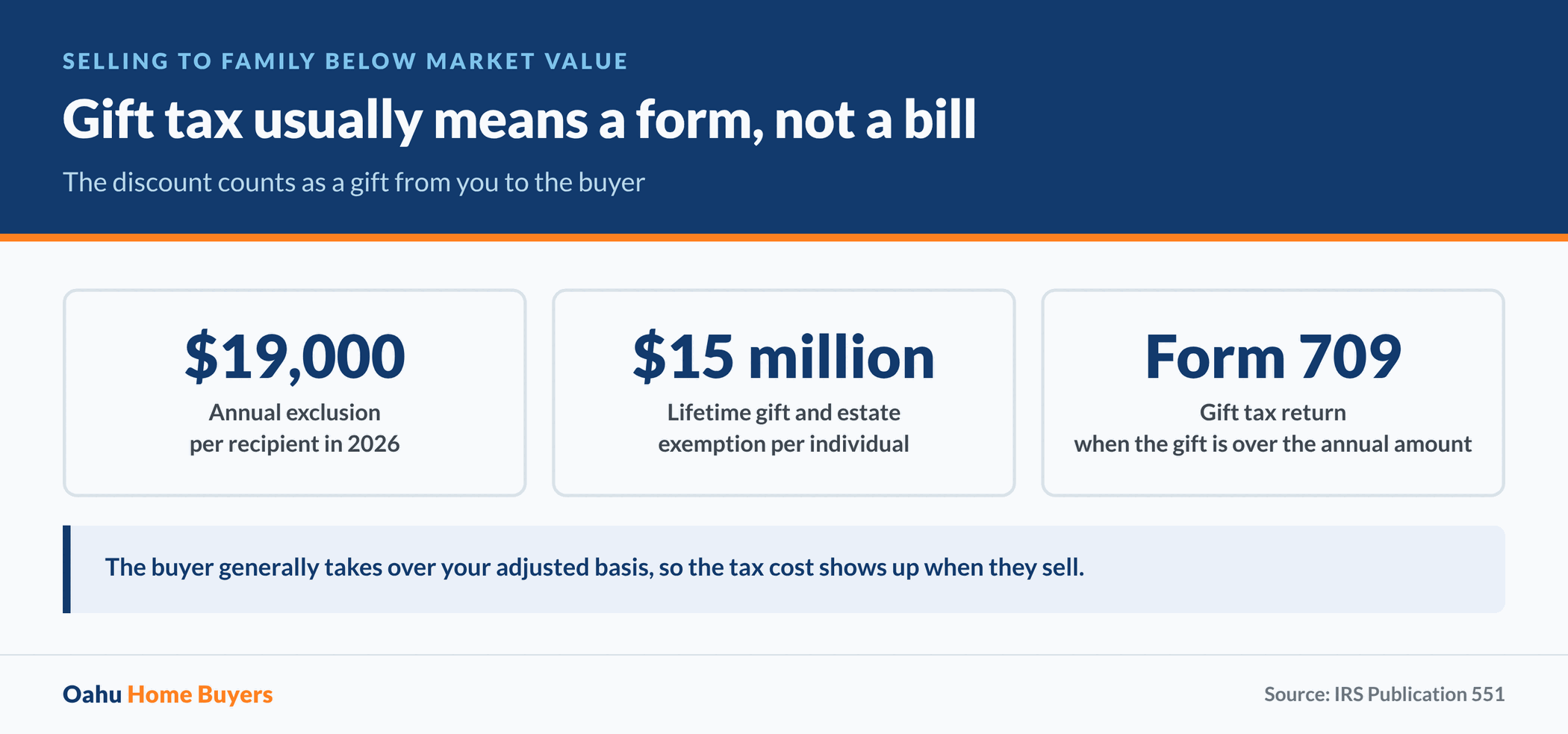
People hear “gift tax” and picture a bill arriving in April. For nearly every family, nothing is owed and the only result is a form.
Sell to a family member below market value and the IRS treats the discount as a gift from you to them. The annual gift tax exclusion stays at $19,000 per recipient in 2026. Anything above that eats into the lifetime gift and estate tax exemption, which is $15 million per person this year.
Say your house appraises $150,000 above the price you’re charging your daughter. Every dollar of that difference counts as a gift. You file Form 709, subtract the annual exclusion, and the rest comes off your lifetime exemption with no check written.
The cost shows up later. A gift generally carries over the giver’s adjusted basis for figuring gain, not the value on the day it changed hands. So your daughter takes on your low basis along with the house, and if she sells in six years, her tax bill reflects what you originally paid. IRS Publication 551 covers bargain buys and gift basis in detail.
Can Selling Below Market Value Trigger an IRS Audit?
Get the paperwork wrong and you could be defending a number from memory three years from now, with penalties and interest stacked on top. One simple folder avoids that.
Family transfers draw more attention than arm’s-length sales. A deed moving a house between relatives for a token amount is public, recorded and easy for a state or federal agency to flag.
Failing to file Form 709 when required is the more common problem. For most families the form is just informational. Skip it, though, and an estate can get messy years later when nobody remembers the details.
What keeps you safe is the file itself. It should hold written proof of value, a signed sales contract and the closing statement. Add a gift tax return when one’s required, and the conversation ends before it starts.
Selling to an investor at a discount rarely raises eyebrows. Two unrelated parties haggling is the textbook case of arm’s length, and the price is its own evidence.
Some states charge their own transfer tax on the deed, and a few base it on assessed value instead of the price you put down. Your county recorder or clerk can tell you how your transfer gets taxed before you record anything.
Do You Need a Lawyer to Sell Below Market Value?
“Can’t I just sign the deed over?”
You can. Whether you should depends on who’s buying. For a plain sale to an unrelated buyer, run through a title company or escrow, you usually don’t need a separate lawyer. Title companies handle these all day.
Family transfers are where an attorney earns the fee. A real estate lawyer drafts the deed correctly and checks that the transfer doesn’t trip your mortgage’s due-on-sale clause. They’ll also work with the CPA who files Form 709. Certain states require an attorney at every closing, so check how yours handles it.
Medicaid planning needs its own warning. Moving a house to family at a discount can affect eligibility for long-term care under lookback rules that differ by state. Your state Medicaid office or an elder law attorney can tell you how your transfer would be treated.
An existing mortgage changes the picture too. If the buyer takes the house subject to your loan, or the loan gets paid off at closing, the sale has to be set up around it. Lenders have opinions here, and you want to hear them before closing day.
Is Selling Your Home Below Market Value the Right Choice?
Even a solid listing usually gives up a slice of the asking price, and two months of carrying costs adds up fast. A direct offer with no repairs, no commission and a set closing date narrows that gap more than the headline prices suggest.
Do the math on your own house. Add up what listing would cost you, from agent commission and inspection repairs to concessions and a few months of mortgage, insurance and utilities. Subtract that from the higher price, then compare it with the direct offer.
Family transfers run on different fuel. Keeping a house in the family at a price your kid can afford isn’t an investment decision, and the carryover basis issue shouldn’t stop you if passing it down is the goal. Just go in knowing the tax bill lands on them later.
A homeowner outside Kapolei called me about a rental she’d never wanted. She’d inherited it, patched the same water heater twice and quit answering her tenant’s Sunday calls. She cared more about being done than about top dollar, and a discount to a buyer who’d take it as is got her there.
Choosing to sell for less is arithmetic plus priorities, not a failure. Talking it over for free with an experienced local buyer such as Oahu Home Buyers usually makes the right path clear.
Frequently Asked Questions
Can I Legally Sell My House to My Child for a Dollar?
Yes, the law lets you set any price you want on your own property. The IRS treats the gap between that price and the home’s value as a gift, though. A gift above the annual amount described earlier means filing a gift tax return, even though most families owe nothing because the excess just trims their lifetime exemption.
Does Selling Below Market Value Help Me Avoid Capital Gains Tax?
Not really. Your gain is measured from your adjusted basis, so a lower price shrinks the gain but rarely erases it for someone who’s owned the place a long time. If it was your main home and you meet the same two-year ownership and use test covered above, the federal exclusion likely covers the rest.
Who Pays the Tax When a House Sells Below Market Value?
You, the seller, handle any capital gains tax and any gift tax reporting tied to the discount. Buyers don’t owe tax for getting a bargain. They do take on your basis for the gifted part, which can mean a bigger bill when they sell, so explain that to whoever’s buying.
Will My Mortgage Lender Allow a Below Market Value Sale?
Your loan generally has to be paid off at closing unless the lender agrees to something else. Most mortgages include a due-on-sale clause that lets the lender call the full balance when the house changes hands. When the price won’t cover what you owe, it becomes a short sale and the lender has to approve it, so call your servicer before you negotiate.
Do I Need an Appraisal Before Selling Below Market Value?
If you’re selling to a relative, get one. A dated, independent appraisal is the cleanest proof of what the house was worth the day you transferred it, and it settles any later question about the size of the gift. In a sale to an unrelated buyer, the negotiated price generally stands as the market value.
How Does Selling Below Market Value Affect Property Taxes for the Buyer?
That depends on your state and county. Some assessors reset the taxable value to the recorded price, and others use their own estimate no matter what the deed says. Several states cap yearly increases, and your county assessor can tell you how a discounted transfer gets handled where the house sits.
Want someone to run the real numbers with you, including your net after costs either way? We’re happy to talk it through, with no pressure and no hard feelings if a traditional listing suits you better.
What Below Market Value Sales Look Like in Hawaii Now
Prices on Oahu have softened this fall. The Honolulu Board of Realtors put the September 2026 median single-family price at $1,110,000, down 3.9 percent from a year earlier. When prices dip, the gap between your price and true market value can shift, so a fresh appraisal matters more.
Oahu owners can see how our team works as cash home buyers in Honolulu.
Our team also buys houses across Hawaii, including homes in Hilo and Lahaina.
Want Help With a Below Market Value Sale?
We’re glad to run the numbers with you, including your net from a listing next to a direct sale to us. Contact us or use the form below. There’s no pressure, and we’ll tell you if a traditional listing fits better.
Helpful Hawaii Blog Articles