

Standing water under a Hawaii house doesn’t dry up on its own. It sits there feeding whatever already grows on the joists, waiting for the buyer’s inspector to crawl in with a flashlight. If you’re trying to sell with a wet crawl space, you know the sinking feeling. In Hawaii it’s a pricing and disclosure problem, though, and both of those have fixes.
Why Does Water in the Crawl Space Scare Off Hawaii Buyers?
Oahu single-family homes sold in a median of 17 days in October 2026, at a median price of $1,170,000, according to the Locations Hawaii market report. Clean houses fly at that pace. Buyers paying over a million dollars in Hawaii have little patience for a home that holds water.
The lender is usually what stalls the sale. An appraiser who notes standing water and subfloor moisture can stop a VA or FHA loan cold, and Hawaii has a large share of military buyers using VA loans. Those buyers often can’t close until the condition is cured.
What scares buyers is less the water than what it hides. Rot you can’t see, termites feeding on wet wood and foundation questions nobody can answer in a short showing all sit behind it. Hawaii’s Formosan subterranean termites love damp timber, and local buyers know it.
Older post-and-pier homes in Kaimuki, Palolo and Manoa sit over crawl spaces that were never built to stay dry all year. Add decades of settling and a neighbor who regraded the yard, and water finds the low spot under your floor.
Not long ago I bought a house in Wahiawa from a retired couple who were three months behind with an auction date already set. The ground under their house flooded every rainy season, and two agents had told them to fix it first. They didn’t have the time or the money, so we bought it as it sat, with their Hilux still parked in the garage.
Is That Crawl Space Water Really Coming From a Septic Issue?
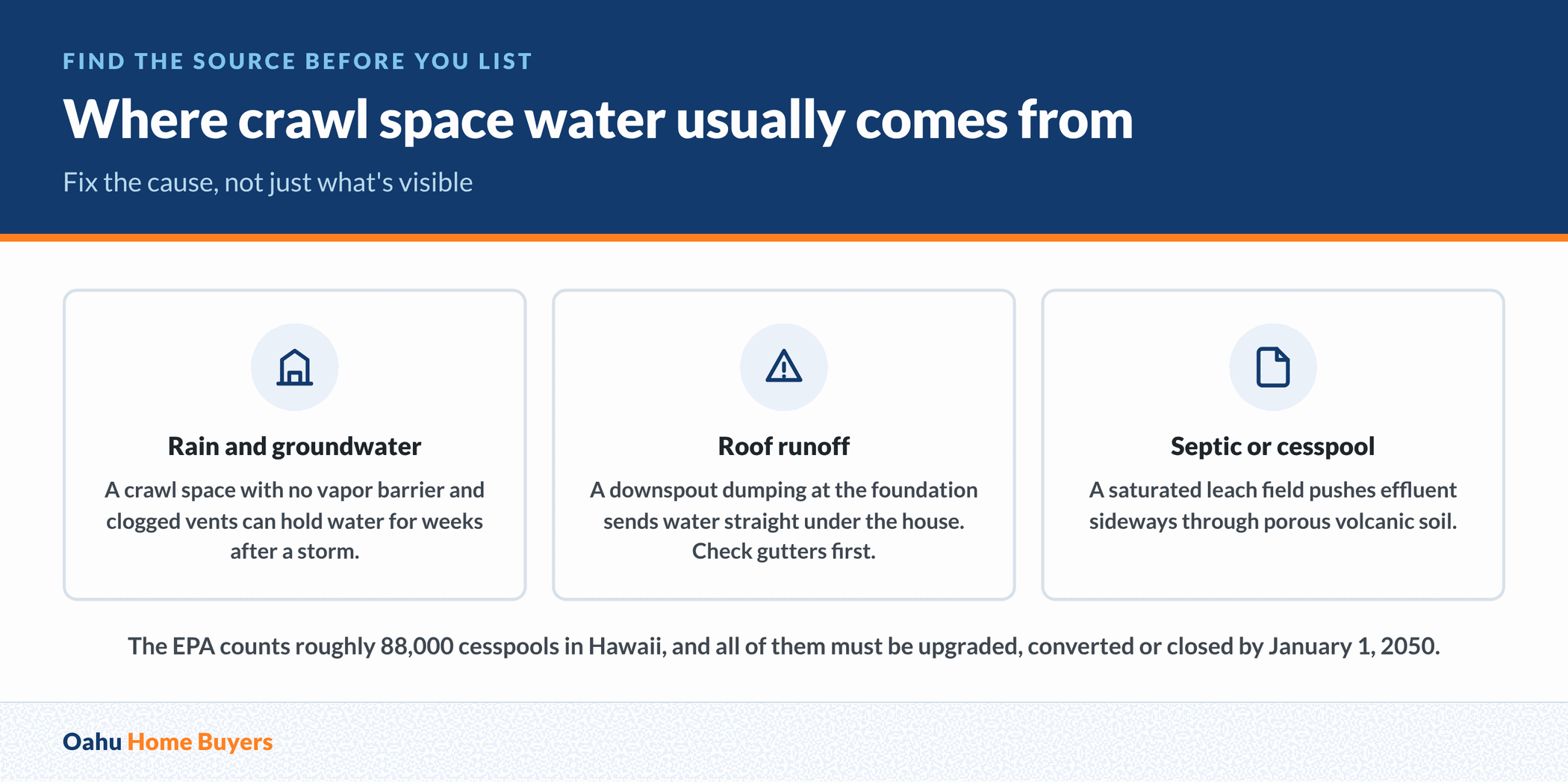
“My plumbing’s fine, so it can’t be the septic.” Maybe. Cesspools and septic systems fail quietly, and Hawaii has more cesspools than any other state. The EPA counts roughly 88,000 cesspools statewide, and state rules require every one to be upgraded, converted, or closed by January 1, 2050.
Soaked leach fields push wastewater sideways through loose volcanic soil. If your house sits downhill of the drain field, that’s where it shows up. Smell gives it away, though plenty of owners have lived with it long enough to stop noticing.
Rain is the more common cause. Kaneohe and Hilo get drenched often, and a crawl space with no vapor barrier and clogged vents will hold groundwater for weeks after a storm. Downspouts dumping roof water at the foundation cause their share too. Check your gutters before you blame the septic system.
Pay for a septic inspection before you list, not after a buyer’s inspector raises it. A few hundred dollars buys the report and settles the question. Guessing wrong on a Hawaii disclosure statement costs far more than finding out.
On Hawaii Island, buyers already watch for this. Nearly 50,000 of the state’s cesspools sit on that island alone, per reporting from The Garden Island, and conversions there cost real money. Standing water next to an old cesspool reads to a buyer as two expensive problems in one coat.
I keep seeing sellers assume standing water means total failure. Often it’s one cracked line or a single collapsed section, and the repair is modest. Find out which one you’ve got.
What Health Risks Come with a Wet Crawl Space Before Selling?
Whatever grows under the floor doesn’t stay there. Air moves up through the floor system and carries it into bedrooms and living rooms.
EPA guidance is direct about this: there are many kinds of mold, and none of them will grow without water or moisture. A damp crawl space in Hawaii supplies that moisture for most of the year. The American Lung Association notes that indoor dampness can trigger asthma and breathing problems even when no mold is visible.
Indoor humidity should stay under 60 percent per EPA advice, and ideally between 30 and 50 percent. Good luck doing that in Waimanalo over wet ground with no vapor barrier.
Rodents and centipedes follow the moisture. Anyone who has lived in an older Hawaii home knows what comes up through a gap in the subfloor when the ground stays wet.
Buyers with kids ask about health out loud. A family touring a Pearl City three-bedroom will smell it from the hallway, and no staging fixes that. Mold remediation quotes in Hawaii tend to run above mainland prices. Contractors stay booked, and the materials ship in.
Testing for mold before listing sounds smart, and I disagree with the usual advice. If you can see or smell growth, a test mostly gives you a report you now have to disclose. The EPA itself says sampling usually isn’t needed when growth is visible, so fix the moisture or price it in.
What Does Hawaii Law Say About Disclosing Crawl Space Water?
Picture a seller in Aiea who patched the problem, painted the vents and said nothing. Six weeks after closing, the buyer’s contractor pulls the insulation and finds black staining on every joist. Then the attorney letters start.
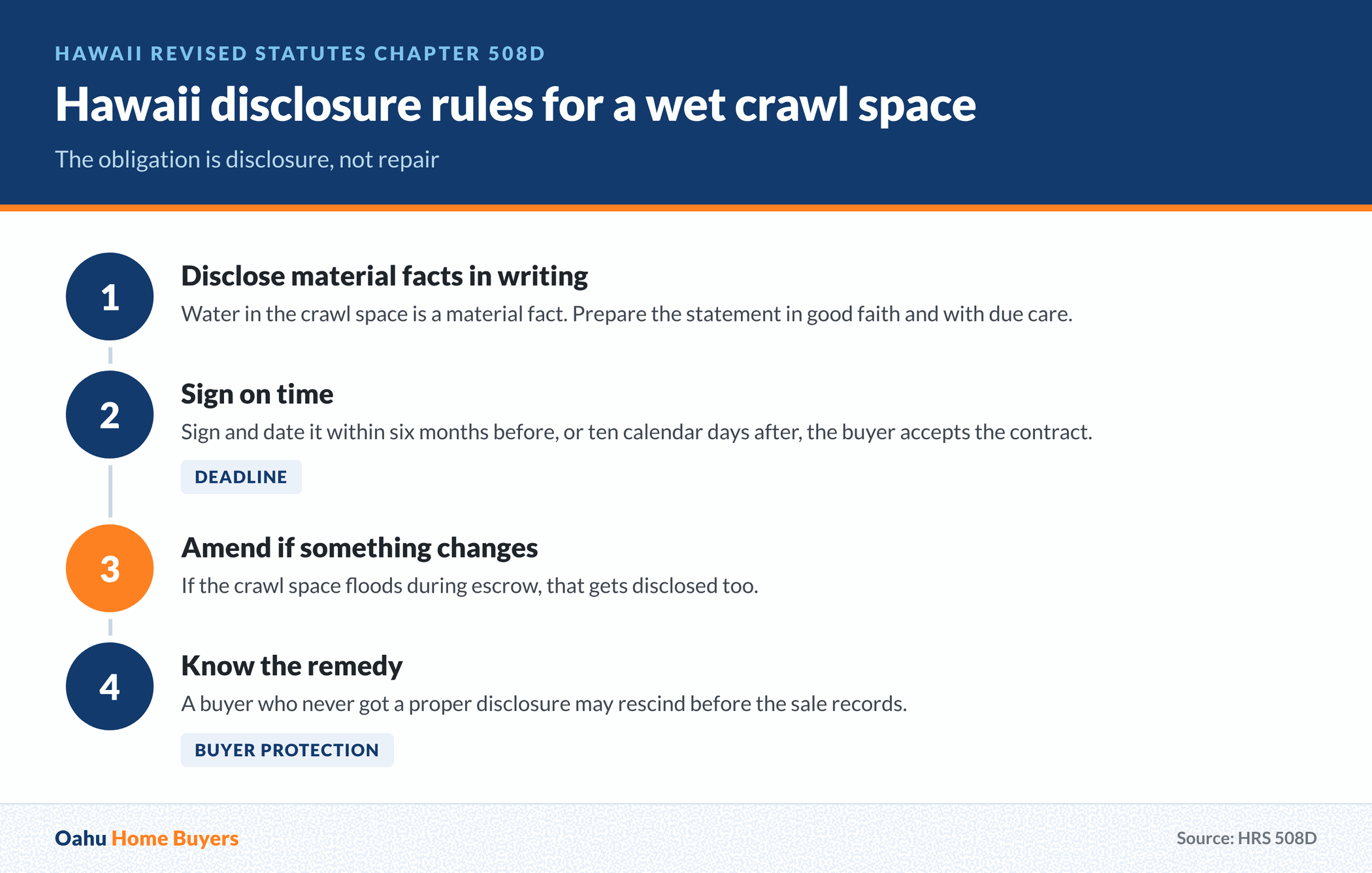
Hawaii’s rules on this are clear. Chapter 508D of the Hawaii Revised Statutes bars selling a home unless the seller delivers a written disclosure statement that fully and accurately covers material facts. Under the statute, you sign and date that statement within six months before, or ten calendar days after, the buyer accepts the sales contract.
Water in the area beneath the home is a material fact in Hawaii. There’s no gray area.
You have to prepare the disclosure in good faith and with due care. Nobody expects you to dig through public records. The standard covers what you know and what you can see in areas you can reach, and you’ve been under that floor with a bucket.
Find something new after you’ve handed over the statement, and Hawaii law calls for an amended disclosure. Say the crawl space floods during escrow after a Kona low parks over the island. That gets disclosed too, and any good agent will tell you the same.
Sellers tend to brush off what happens when a disclosure falls short. Chapter 508D gives buyers remedies, including the right to cancel in some cases. Laws change, so check the current rules with your attorney or the Hawaii Association of Realtors rather than your neighbor’s memory.
Where Does Crawl Space Water Show Up on the Disclosure Form?
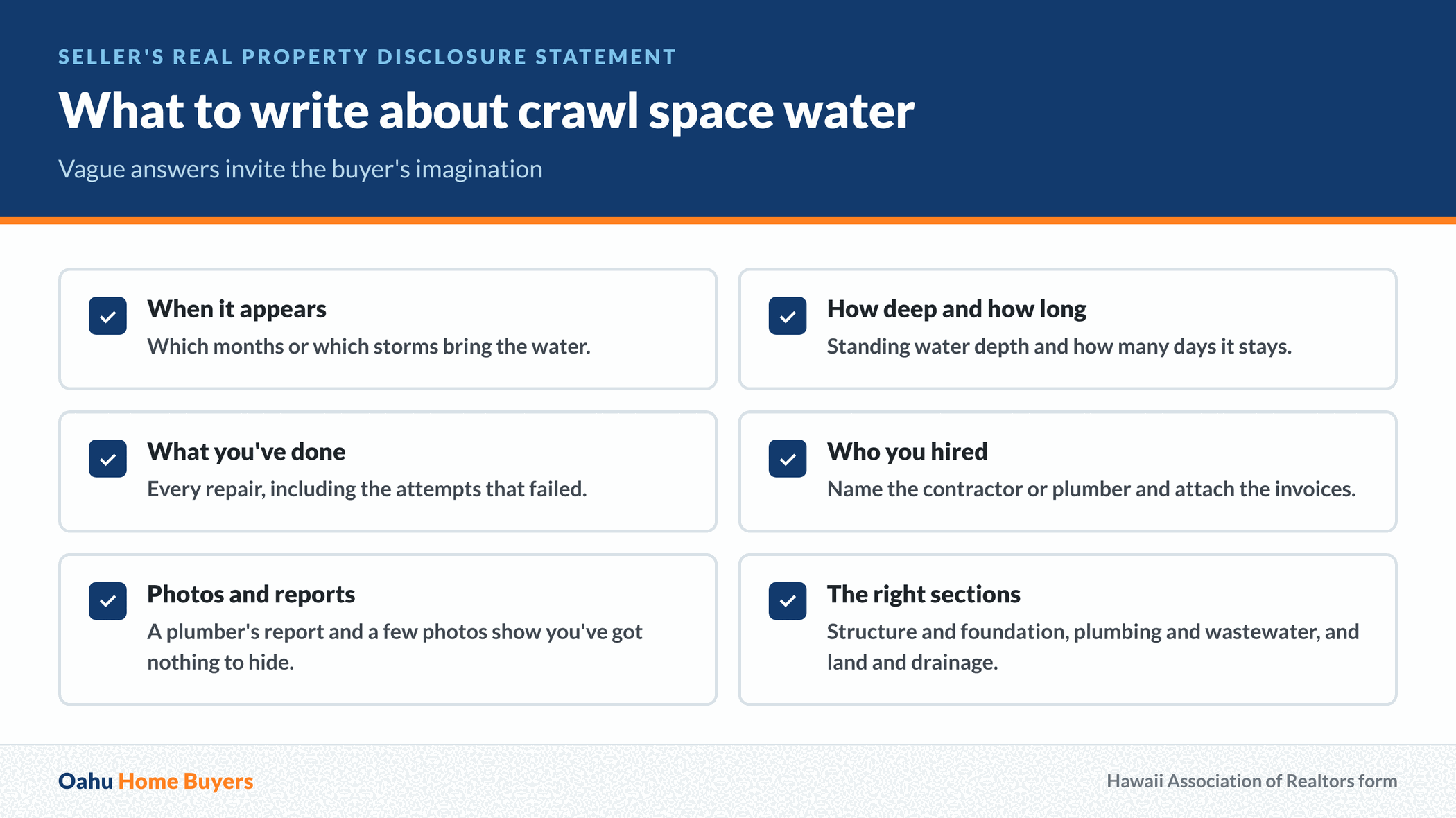
Write more than feels necessary. The Hawaii Association of Realtors Seller’s Real Property Disclosure Statement has several spots where crawl space water belongs, and sellers tend to check one box and move on.
Begin with the section on the structure and foundation. Water getting in, settling and the state of the subfloor all go there. Septic or cesspool trouble belongs in the plumbing and wastewater section, and the land section covers drainage, grading and flooding history.
Vague answers hurt you. “Some moisture” lets the buyer’s imagination fill in the rest, and imagination always costs more than facts.
I’d write down when the water shows up, how deep it gets and how long it stays. Then list what you’ve done about it and who did the work, and attach the invoices. Hawaii sellers who hand over a plumber’s report and a few photos of the space under the house look like people with nothing to hide, and that trust carries into the talks.
Disclose the repair attempts that failed, too. Sellers skip those because failed work looks bad. It looks worse when the buyer’s inspector finds a French drain nobody mentioned.
If your property sits in a flood hazard zone or a tsunami evacuation area, buyers will tie that to the water question fast. Mention it plainly.
Your agent can walk you through each line, but the answers are yours. The law puts that duty on the seller, so sign nothing you haven’t read.
How Much Does Crawl Space Water Damage Hurt Your Sale Price?
An heir listed a Hilo-side house one spring with standing water under the floor. Three price drops followed, and the buyer who finally signed paid well under the original ask.
Timing punishes houses with problems. On Hawaii Island, the median single-family price was $509,000 in October 2026, and homes sold in a median of 40 days, reported in the island’s October market update. A house with water underneath doesn’t get that long before the first price cut.
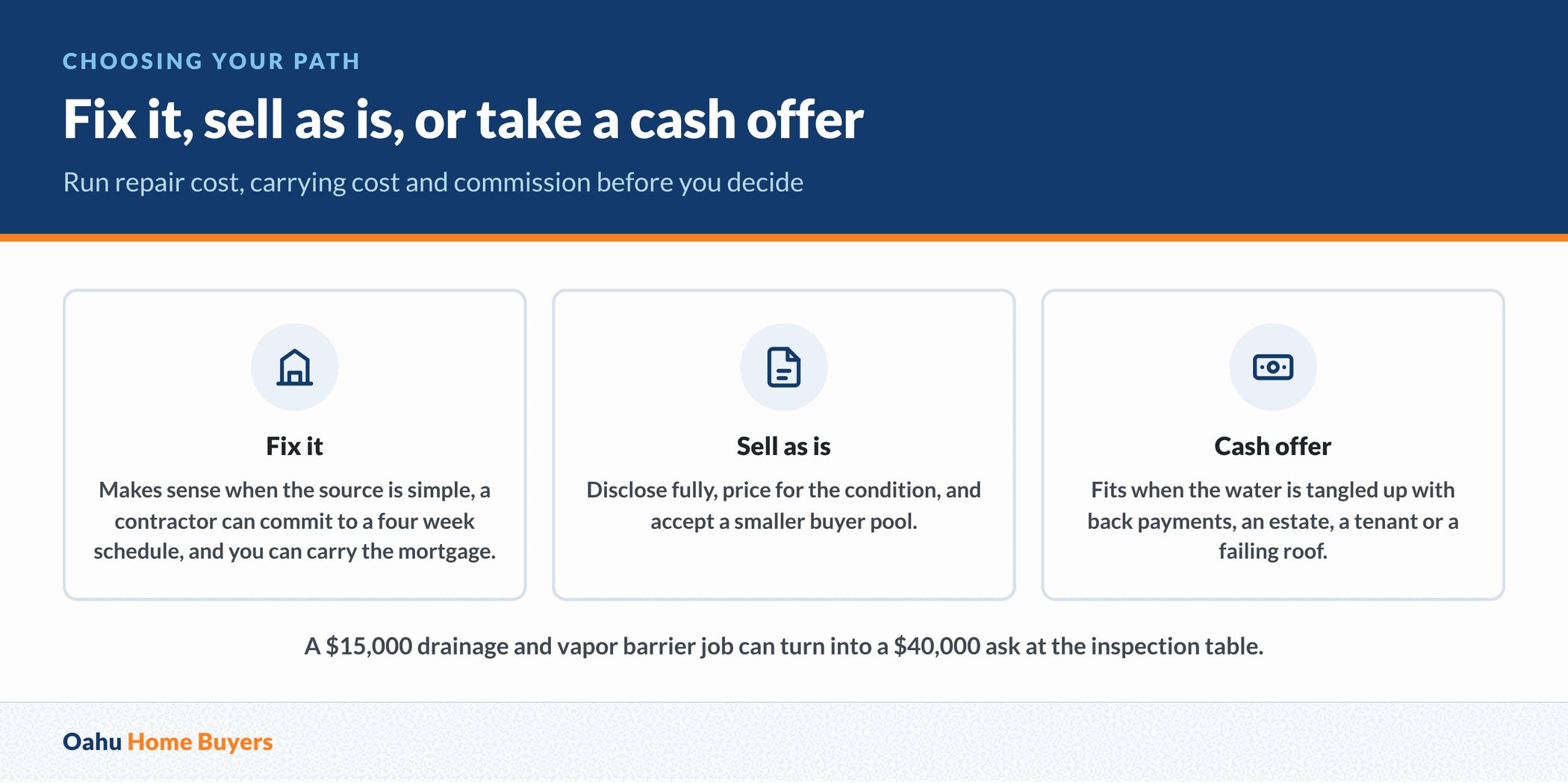
Buyers don’t just subtract the repair bill. They add a risk premium and the hassle of hiring contractors in a state where good ones are scarce. A $15,000 drainage and vapor barrier job can turn into a $40,000 ask at the inspection table.
Water damage also weakens your hand at the worst moment. Once you’re under contract and the report lands, the buyer holds the leverage, and your agent’s advice shifts from holding firm to keeping the sale alive.
Financing adds a second hit. Bank and government loans both balk at active moisture and visible mold, so your buyer pool shrinks toward cash and renovation loans. Fewer buyers means a lower price.
Across the houses we’ve bought, sellers who fixed the crawl space properly and kept the paperwork got most of that discount back. Sellers who did a cosmetic patch got none of it, because Hawaii inspectors find fresh paint on old rot all the time.
Should You Fix the Crawl Space, Sell As-is, or Take a Cash Offer?
Pick wrong and you can spend more on a crawl space repair than it adds to your price. It happens a lot in Hawaii, mostly because sellers fix what they can see instead of what’s causing the water.
Fixing makes sense when the source is simple and you have time, like regrading, new gutters or a vapor barrier. If a licensed contractor can give you a firm scope and a four-week schedule, and you can carry the mortgage in the meantime, repair usually wins on a Hawaii listing.
Selling as is on the open market is the middle path. You disclose fully, price for the condition and accept a smaller buyer pool. Oahu’s single-family market was still moving in October 2026 according to island market reporting, so there’s real demand even for projects.
Cash fits best when the problem under the house is tangled up with something else, like back payments, an estate or a failing roof. Investors buy the whole mess, not just the house, and that’s where we help. Oahu Home Buyers looks at properties like this across the island.
Run the numbers honestly before deciding. Count the repair, the carrying cost and the commission against the price you’d realistically get afterward.
A landlord in Kapolei called me last year after part of his crawl space had stayed wet for months. His tenant had stopped paying in February, and he’d never wanted to be a landlord since the house came from his mother. He sold it to me rather than spend another Saturday under there with a shop vac.
Frequently Asked Questions About Selling with Crawl Space Water
I used to tell sellers to fix everything first. That advice cost people money, and I stopped giving it.
Is It Normal to Have Water in a Crawl Space?
Some dampness under a Hawaii house is common, mostly in the rainy months on windward shores. Standing water that lingers for days isn’t normal and points to a drainage, plumbing or wastewater problem. In a climate this humid, ground that never dries keeps damaging the framing and draws pests, so treat it as a real condition.
Is It Hard to Sell a House with a Crawl Space in Hawaii?
Crawl spaces are everywhere in Hawaii, above all under older post-and-pier homes, and buyers don’t mind them when they’re dry and vented. Trouble starts with moisture, rot or termites underneath. A dry one with a clean inspection is a non-issue, while a wet one shrinks your buyer pool and gives the rest of them leverage.
How Much Does Crawl Space Water Lower a Hawaii Home’s Value?
Expect buyers to knock off more than the repair bill, since they price in risk and the hassle of hiring contractors. How much depends on whether water is still getting under the house or already stopped, how far the damage reached into the framing and whether mold is visible. A documented repair with receipts wins back most of that discount, while an unfixed problem can cost you the sale when financing falls through.
Do I Have to Fix the Crawl Space Before Selling in Hawaii?
No Hawaii law makes you repair anything before you sell. The obligation is disclosure, not repair. You’re free to sell a house with a wet crawl space as is, as long as you tell the buyer the truth in writing and don’t hide what you know.
Will a Cash Buyer Still Want My House with a Wet Crawl Space?
Usually, yes. Investors price water damage into the offer instead of walking away, since this kind of fix is routine work for a buyer who redoes houses. You’ll get less than a fully repaired house would bring, but you skip the repairs and the loan contingency that often sinks these sales.
Sitting with a wet crawl space and a decision you didn’t ask for? We’re happy to look at it with you and talk through repairing, listing or selling to us, with no pressure and no sales pitch.
What Oahu Buyers Notice Right Now
Oahu buyers have more time to shop right now. The Honolulu Board of Realtors reported that October 2026 condo resales fell 23.5 percent from a year earlier. Condo prices slipped too, with the median dipping below $500,000 for the first time in nearly a year. A wet crawl space stands out more when buyers aren’t rushing.
Homeowners in town can see how our team works as cash home buyers in Honolulu.
We also buy houses across Hawaii, including homes in Hilo and Lahaina.
Have a Wet Crawl Space and Questions?
Tell us a little about the house and what’s happening under it. We’ll look at your options with you and give you an honest take on repairing, listing or selling to us. Contact us or fill out the form below whenever you’re ready.
Helpful Hawaii Blog Articles