

The title report on a Kaneohe house comes back, and there it is. A contractor recorded a lien over a bathroom remodel nobody remembers finishing. Neither the seller nor the agent had any idea. One line like that has stalled plenty of Hawaii closings, and most of the time it didn’t have to.
Your house isn’t frozen because of a lien. Think of it as a claim on the sale money, not a padlock on the door. When someone handles it the right way, the sale still closes.
What Is a Property Lien in Hawaii?
Picture a Mililani seller who paid off her mortgage and figured she owned the place free and clear.
A lien in Hawaii is a legal claim recorded against real property to secure a debt. Someone is owed money, and that claim stays with the house until it’s paid, released or expires. Most get recorded at the Bureau of Conveyances in Honolulu. The state runs one recording office for every island instead of a recorder in each county.
This setup reaches a long way. Under Hawaii Revised Statutes section 636-3, a money judgment from a state court or the federal court in Hawaii becomes a lien on real property once a certified copy is recorded with the Bureau. One filing in Honolulu can attach to land the debtor owns in Hilo, Lihue or Lahaina.
The islands also run two title systems side by side, and sellers trip over this all the time. Most parcels are regular recorded land. Others are Land Court registered property, with its own chapter of law and its own assistant registrar. Ask your escrow officer early which one covers your parcel.
Does a recorded lien mean you’ve lost the house? No. It means a creditor has locked in a place in line to get paid when you sell or refinance.
I’ve sat at kitchen tables with owners who assumed that kind of claim meant foreclosure was automatic. It isn’t. A claim like this can sit on title for years while you live there, and you may not feel it until the day you list.
What Types of Liens Can Be Placed on a Hawaii House?
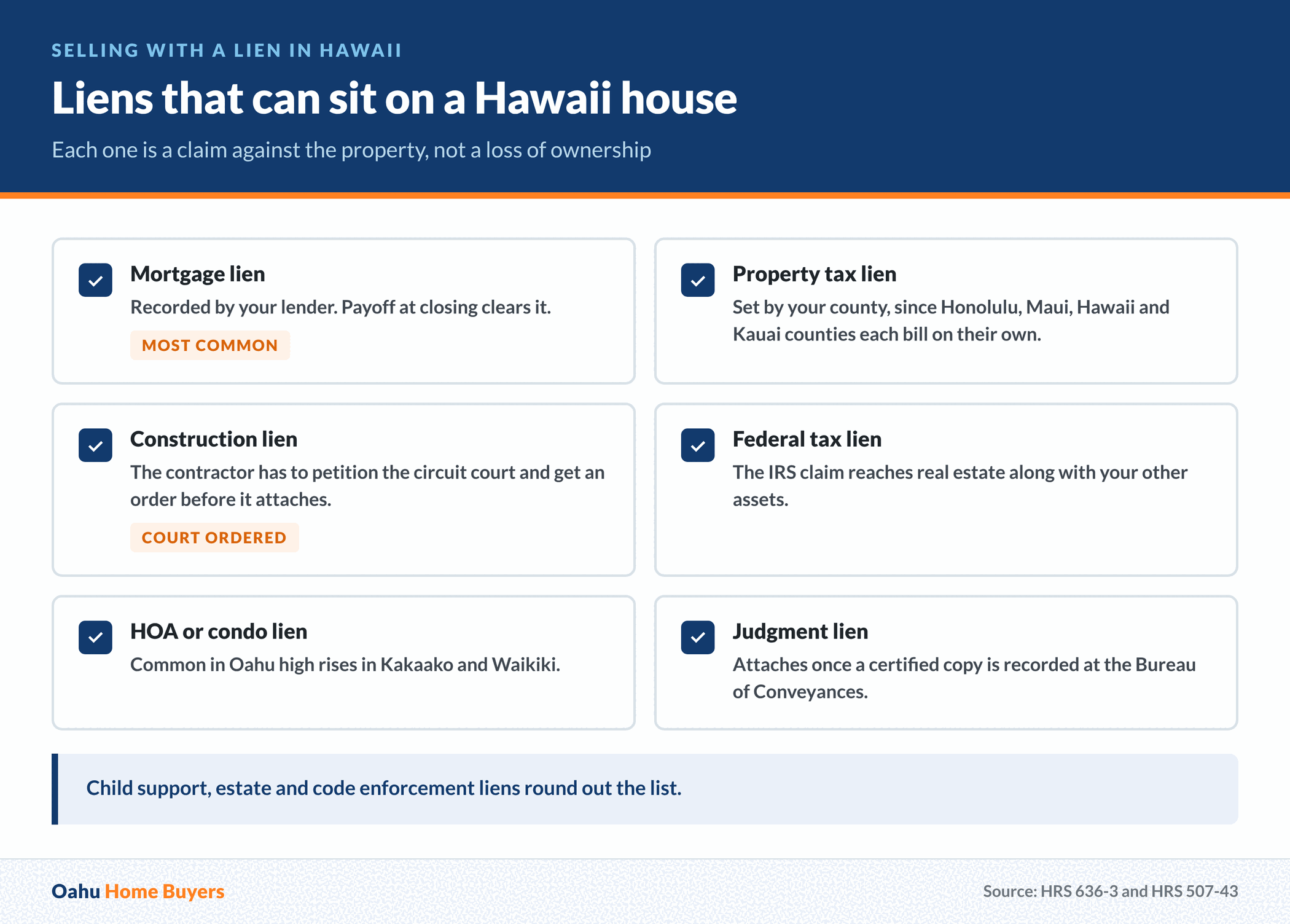
For years I lumped every claim into one bucket and treated them as equally hard to clear. That was a mistake, and it cost sellers time.
Mortgage liens are the everyday kind. You borrowed, the lender recorded its lien, and the payoff at closing clears it.
Property tax liens come from your county, not the state. Each of the four counties bills real property tax on its own calendar. Ask the county tax office what’s owed and what penalties have been added.
Construction claims work differently here than almost anywhere else. A Hawaii mechanic’s lien doesn’t attach just because someone records a form. The contractor has to petition the circuit court, serve notice and sit through a hearing before a judge orders it to attach.
Under HRS section 507-43(b), the filing window is 45 days after the date of completion of the improvement. Whoever claims the lien files that application with the circuit court inside the window, per the statute posted by the Hawaii State Legislature. Once the court enters its order, the lien expires three months later unless the claimant starts collection.
Federal tax debt is a separate animal. The IRS calls a federal tax lien the government’s legal claim against your property when a tax bill goes unpaid. It reaches real estate along with everything else you own.
Condo owners run into association liens a lot, especially in the high-rises of Kakaako and Waikiki. Child support, estate claims and code enforcement can each put a lien on title too.
Can You Sell a House with a Lien in Hawaii?
Ignore a lien and you’ll likely learn about it eight days before closing. That’s when the buyer’s lender refuses to fund and your moving truck is already booked.
Yes, you can sell a Hawaii house with a lien on it. What you can’t do is hand over clear title with the claim still attached. Somewhere along the way, it gets paid, released, subordinated or discharged.
Early last year I bought a place in Waianae from an heir who lived in Oregon. She’d inherited her father’s house and fallen behind on the mortgage, and a judgment lien she’d never heard of sat on title. His surfboard rack was still in the garage when we closed, and the payoff cleared both debts.
Hawaii is a lien theory state, and that shapes everything. The lender holds a security interest, and the house stays yours. A recorded lien is a claim against your ownership. Title never moved, which is why you keep the right to sell.
Cash buyers have more room to work with a title problem than financed buyers do. Bank lenders won’t fund a loan against clouded title. An investor using their own money can sometimes work around a stubborn lien or wait out a slow release that a 30-day rate lock can’t survive.
Will the payoff eat all your equity? It depends on the number, so get the real payoff in writing before you set a price.
How Does a Lien Affect Selling Your Hawaii Home?
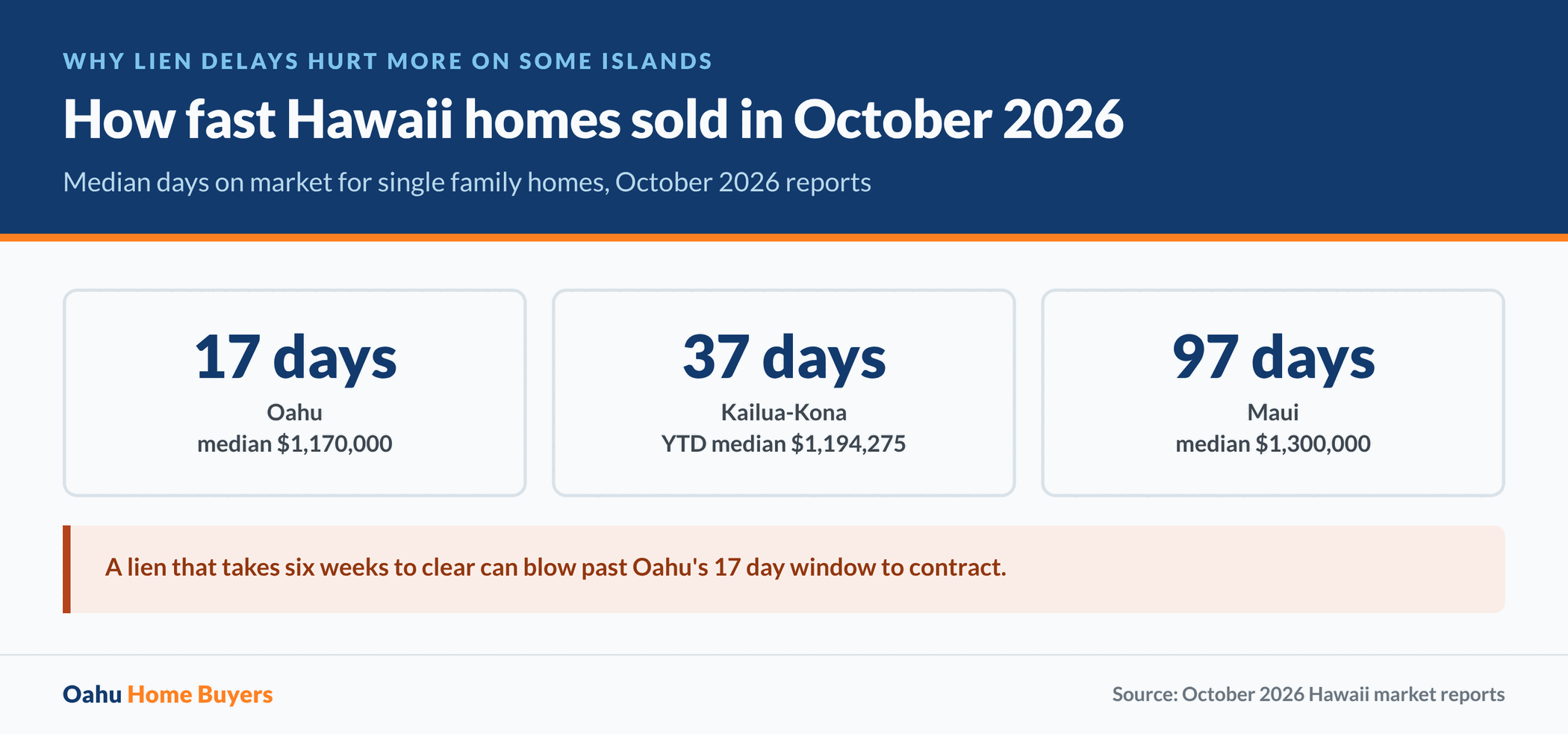
Delay hurts a Hawaii sale far more often than the debt itself.
Each lien means chasing a payoff demand, then waiting on a release to record. Stack three of them and you’ve added weeks to a sale this market may not wait for.
Speed varies a lot by island right now. Oahu’s October 2026 median single-family price was $1,170,000, flat with a year earlier. Median days on market fell 37 percent to just 17 days, according to the Locations Hawaii market report. That’s under three weeks to an accepted contract, plus another month or so to close. A title fix that drags on for six weeks will blow right past it.
Maui moves on a slower clock. Its October 2026 median came in at $1,300,000, up 4 percent from a year earlier, and homes took a median of 97 days to sell. Sellers in Kihei have more time to sort out title than sellers in Kailua do.
Island buyers have been burned before. When their agent sees a construction lien and a judgment on the preliminary report, offers come in lower or with longer contingencies.
I keep seeing sellers try to hide a lien and hope escrow sorts it out quietly. It never works. You lose credibility with the few buyers shopping your price range, and on an island that’s hard to win back.
How Do You Remove a Lien Before Selling in Hawaii?
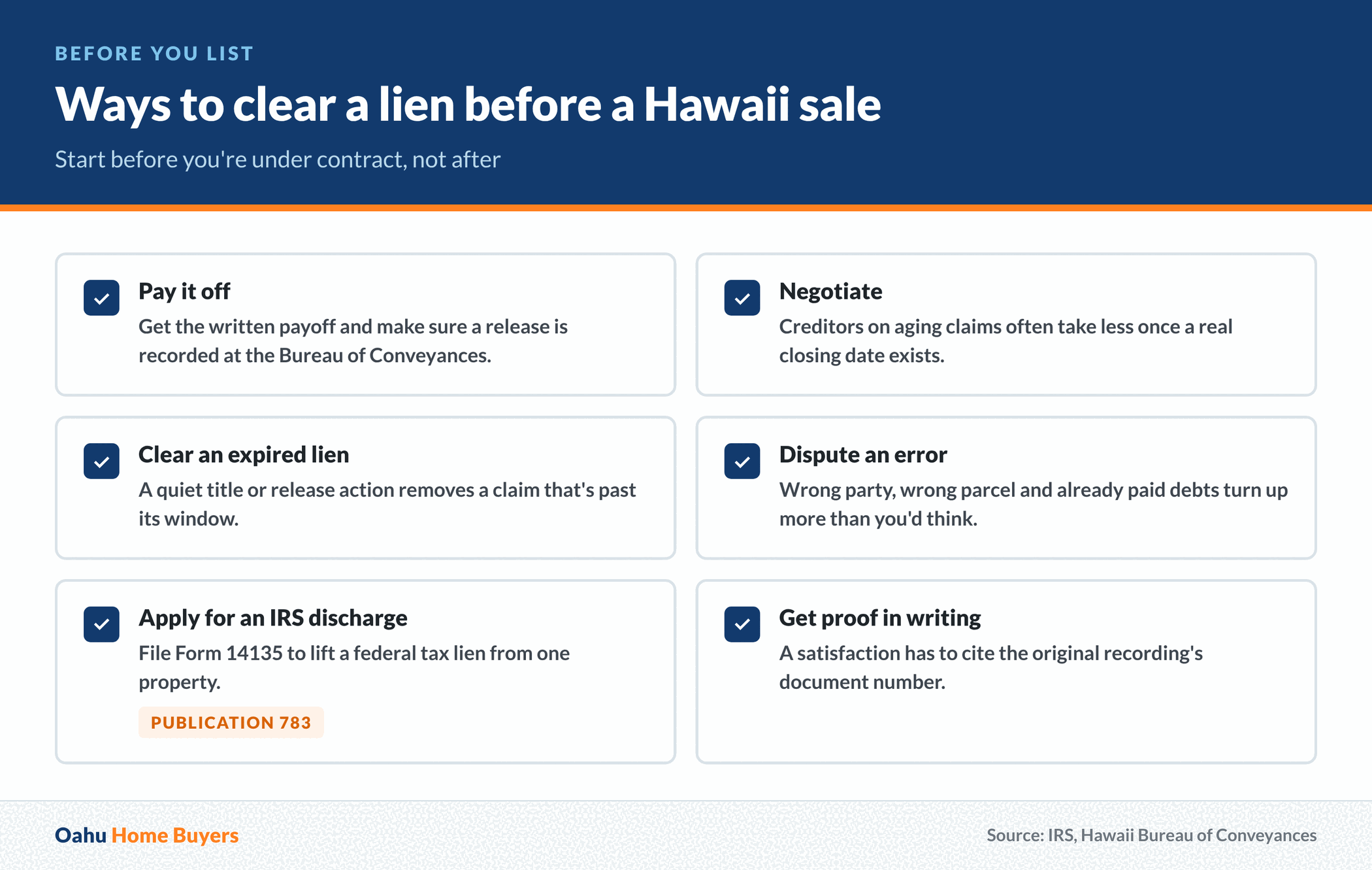
Say a roofing contractor records a lien after a fight over a leak repair, and you’d already paid most of the bill. It happens more than you’d hope, and it’s fixable.
Paying it off is the cleanest route. Get the payoff in writing, pay it, and make sure the creditor records a satisfaction or release with the Bureau of Conveyances. A satisfaction of judgment has to cite the book and page or document number of the original recording. Don’t accept a vague letter as proof the debt is gone.
Creditors sitting on an old claim will often take less than face value for money they can count on. I’ve watched medical and credit card liens settle well under the recorded amount once a real closing date was on the calendar.
An expired lien can be cleared on paper. A construction claim that missed its enforcement window no longer secures anything, yet it still clouds title until somebody files to remove it. That takes a quiet title or release action, which a Hawaii real estate attorney handles.
Mistakes turn up too, like a debt that was paid years ago or the wrong parcel number. Common surnames make it worse in a statewide index, where one person’s lien can land on someone else’s title.
Federal tax debt has its own path. A discharge removes the federal tax lien from one specific property, and Publication 783 on the IRS website lays out the steps. You apply with Form 14135.
Start this before you list, not after you’re under contract.
What Happens to a Lien at Closing in Hawaii?
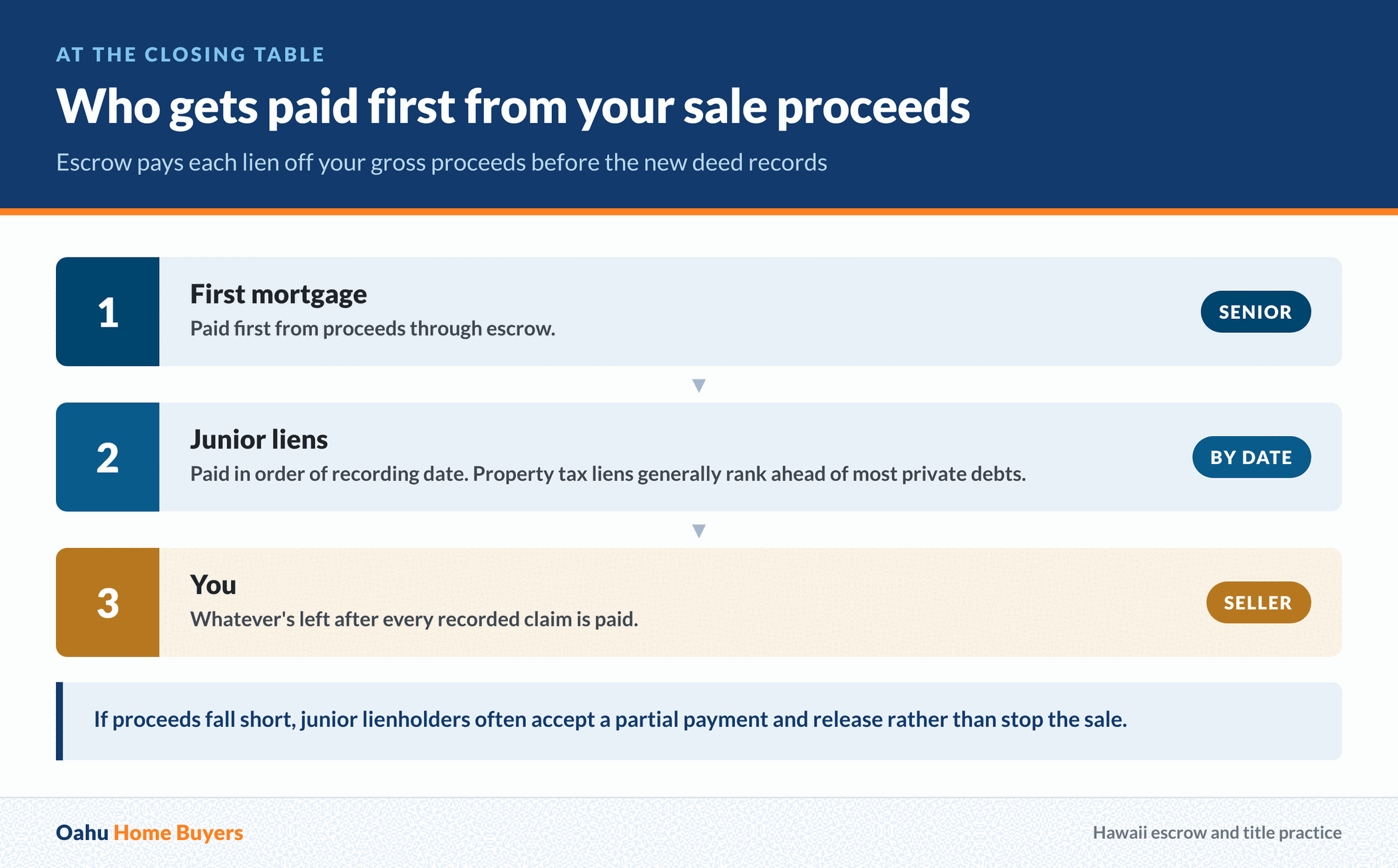
Most sellers never write a check for any of this. Escrow takes it out of the proceeds.
Hawaii escrow companies order title, collect a payoff demand from every recorded claimant and pay them when the deed records. Your settlement statement shows each lien as a line coming off your gross proceeds.
Priority sets the order. The first mortgage gets paid first, then junior claims by recording date. Property tax liens generally rank ahead of most private debts. If the proceeds come up short, the junior creditors have a choice to make.
Escrow or your attorney sends each junior claimant the math: the price, the senior debt and what’s left. Many take a partial payment and sign a release rather than block a sale that would leave them with nothing.
When the numbers simply don’t work, you’re looking at a short sale. It’s the servicer’s call, not something Hawaii law decides.
Federal claims need extra lead time. The IRS asks for a discharge application about a month and a half before the sale, so bring up any federal tax lien the day you decide to sell.
Releases record at the Bureau of Conveyances along with your new deed. Until they hit the record, the lien technically still sits on the property.
How Do You Sell a Hawaii Home Quickly with a Lien on Title?
Cash buyers can’t make a lien vanish. It still gets paid at closing. What changes is the timeline, and who carries the risk while you wait.
We can accept a property with a pending release, extend when a county office is slow, and keep the sale on track through problems that would sink a financed buyer.
Softer prices in parts of Hawaii make this matter more. Kailua-Kona’s year-to-date median single-family price was $1,194,275 as of the October 2026 report, down 5.2 percent from a year earlier. Median days on market there rose 32.1 percent to 37 days. Falling prices shrink the equity that pays off a lien.
Some sellers want full retail for a house with a contested construction claim and years of deferred repairs, and the math won’t close. Oahu Home Buyers sees this often and will tell you plainly when listing with an agent nets you more. In plenty of cases, it does.
Pull your papers together now. You’ll want copies of the recorded lien, any payoff letters and your notes from talking with the creditor. Organized sellers close faster, in my experience every time.
Who Can Answer Your Lien Questions in Hawaii?
You might figure a lawyer will cost more than the lien is worth. On a small, clear-cut claim, you could be right. For a court-ordered construction claim, estate property or competing claims, an hour of a Hawaii real estate attorney’s time is cheap insurance.
Your escrow officer reads Hawaii title reports every day and can tell you fast whether a lien is routine or ugly. Ask them to walk you through each exception line by line.
Title companies issue the preliminary report that shows everything recorded against your parcel. An early title search is the cheapest way a seller can avoid a bad surprise.
For judgment questions, the Hawaii State Judiciary publishes the Land Court rules on how attachment, mechanic’s and judgment liens get recorded against registered land. Late property tax bills go through the county tax office. Recorded documents and copies come from the Bureau of Conveyances.
Federal tax questions go to the IRS Centralized Lien Operation. The Taxpayer Advocate Service also posts plain guidance on lien discharge if you’d like to read up before hiring anyone.
One Waipahu landlord called me as she was moving her mother into assisted living. Her tenant had left mid-renovation, and an unpaid contractor had already filed in circuit court. An attorney settled the claim, we closed on the rental, and it was behind her before Thanksgiving.
Frequently Asked Questions
What Does It Mean That Hawaii Is a Lien Theory State?
Your mortgage lender holds a security interest in the house rather than legal title. You stay the owner the whole time you’re making payments. A lender with a recorded claim has to go through a legal process to collect, and you keep the right to sell and pay off the debt from the proceeds.
Can You Sell a Hawaii House with an IRS Lien on It?
Yes. You apply for a certificate of discharge with the IRS form mentioned above, and it lifts the federal claim from that one property so the sale can record. The IRS usually wants either the proceeds its claim is owed or proof that senior debts are larger than the home’s value. Send it well before your closing date, because review takes time.
How Do I Find Out If There’s a Lien on My Hawaii Property?
Order a preliminary title report from a local title or escrow company, which gives you the fullest picture. You can also search records at the Bureau of Conveyances, and your county tax office can tell you about unpaid property tax. If you’ve had contractors, lawsuits or unpaid association dues lately, assume something could be there and check before you list.
Who Pays the Lien When a Hawaii House Sells?
You do, nearly always from the sale proceeds at closing rather than out of pocket. Escrow collects a payoff figure from each claimant and pays them before the new deed records. If the price won’t cover every debt, the creditors who come up short have to agree in writing to release for less.
Can a Buyer Back Out Over a Lien in Hawaii?
Usually, yes. Standard sales contracts give the buyer time to review title. If the preliminary report shows a claim you can’t clear by closing, the buyer can typically cancel and get the deposit back. Telling them what you know early keeps a fixable problem from sinking the sale.
Does a Lien Expire on Its Own in Hawaii?
Some do. A construction lien has the short court-ordered life span covered above, and a judgment lien lasts only as long as the judgment can be enforced. An expired claim still shows on title until someone records a release, so the date passing doesn’t hand you clean title.
Stuck with a title report you can’t make sense of, or a creditor who won’t give you a straight answer? Reach out. We’ll look at your situation, tell you whether selling direct or listing fits better, and point you to the right office if that’s all you need.
What a Lien Means for Oahu Sellers Right Now
Oahu’s market cooled a little this fall. The Honolulu Board of Realtors reported that October 2026 condo resales fell 23.5 percent from a year earlier. Condo prices slipped too, with the median under $500,000 for the first time in nearly a year. Slower sales give a lien more time to cause trouble, so clearing title early pays off.
Homeowners in town can see how our team works as cash home buyers in Honolulu.
We also buy houses across Hawaii, from Hilo to Lahaina.
Have a Lien on Your Hawaii House?
Send us the basics about your property and the lien, and we’ll walk through your options together. It costs nothing, there’s no obligation, and we’ll tell you if listing makes more sense. Contact us or fill out the short form below.